You had your C-section months ago, maybe even a year or two. The scar healed, the baby is growing, life is busy. Then one day, while picking up your toddler or coughing in the kitchen, you notice a soft bulge near the scar or the belly button. It goes away when you lie down. Is it just loose skin?
Often it isn’t. A hernia after C-section is more common than most women realise, and most women are never told to watch for it. This guide from Apex Hospital, Sirsa, India, covers how a C-section hernia shows up, why it happens, when it needs attention, and how it is repaired.
What Is a Hernia After C-Section?
A hernia is a gap in the abdominal wall that lets tissue, usually fat or a loop of bowel, push through. After a C-section, the cut in the abdominal wall heals with a scar. If that scar area stays weak, the contents underneath can slowly push out. Surgeons call this an incisional hernia.
Women can also get an umbilical hernia during or after pregnancy. Growing pressure inside the abdomen can stretch the tissue around the belly button until it gives way.
The two are different problems, but they look similar and are often confused. The table below shows the usual differences.
| Incisional hernia | Umbilical hernia | Diastasis recti | |
|---|---|---|---|
| Where | At or near the C-section scar | At the belly button | Along the midline above and below the navel |
| What it is | Weak scar tissue | Gap around the navel | Muscle separation, not a true hernia |
| Typical feel | Soft lump, may ache | Soft bulge, may be tender | Painless ridge or doming when you sit up |
| Needs surgery? | Often, if symptomatic | Often, if symptomatic | Usually not |
How Common Is a C-Section Hernia?
Less common than the worry it causes, but not rare. A systematic review of incisional hernia after cesarean section by Paulsen and colleagues found reported rates between 0.0% and 5.6%, with follow-up ranging from six months to ten years. The authors concluded that the overall risk is low, but that the numbers vary widely between studies.
For umbilical hernias in pregnancy, a review in Frontiers in Surgery by Kulacoglu puts the incidence at about 0.08% of pregnancies. It also notes that symptoms most often appear in the second trimester.
So if you have a bulge, you are not imagining it, and you are not alone.
Signs of a Hernia After C-Section
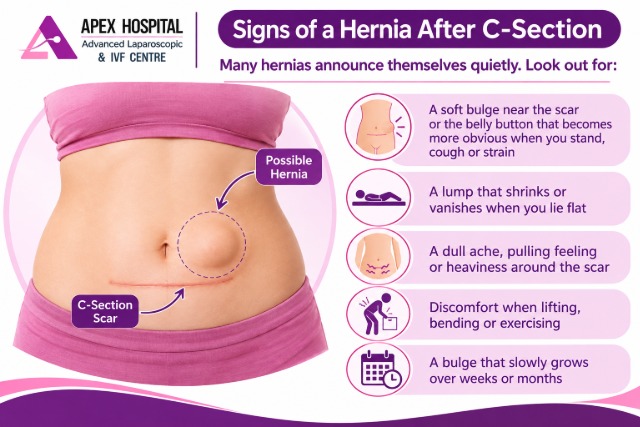
Many hernias announce themselves quietly. Look out for:
- A soft bulge near the scar or the belly button that becomes more obvious when you stand, cough or strain
- A lump that shrinks or vanishes when you lie flat
- A dull ache, pulling feeling or heaviness around the scar
- Discomfort when lifting, bending or exercising
- A bulge that slowly grows over weeks or months
Signs that need urgent care
Please do not wait if you notice any of the following:
- Sudden, severe pain at the bulge
- A lump that becomes hard, tender or impossible to push back
- Redness or a dark, purplish colour over the bulge
- Vomiting, bloating, or not passing gas or stool
- Fever along with a painful bulge
These can mean the hernia is trapped (incarcerated) or that its blood supply is cut off (strangulated). Kulacoglu’s review points out that every hernia carries this risk, and that a trapped or strangulated hernia needs emergency repair.
Why Does a Hernia Form After a C-Section?
Think of the abdominal wall as a fabric. Pregnancy stretches it. A C-section cuts it. Healing then has to hold the repair together while the abdomen is under constant pressure.
Factors that make a C-section hernia more likely include:
- Wound infection or poor wound healing after surgery
- Excess weight or obesity, which raises pressure on the repair
- A vertical (midline) incision rather than the usual low horizontal one
- Multiple C-sections, since each scar weakens the wall further
- Diabetes and smoking, which slow healing
- Early heavy lifting before the wall has strengthened
- Straining from chronic cough or constipation
- Repeated pregnancies, which stretch the abdominal wall again and again
Most of these are partly in your control, which is good news for prevention.
Hernia vs Diastasis Recti: Don’t Mix Them Up
This is the question we hear most from new mothers. Diastasis recti is a separation of the two rectus muscles along the midline. It is very common in pregnancy and can persist after delivery. It often looks like a ridge or dome when you sit up, and it is usually painless.
It is not a true hernia, but it can sit alongside one. It also matters for planning surgery, because the same review notes a higher recurrence risk in patients with rectus diastasis, especially after suture-only repair.
How Is a C-Section Hernia Diagnosed?
Diagnosis usually starts with a physical examination. We examine you lying down and standing, and ask you to cough or lift your head so the bulge shows itself. An ultrasound confirms the defect and helps tell a hernia from diastasis or a scar lump. In difficult or large cases, a CT scan may help plan the repair.
Not sure what type you have? Our guide to the types of hernia and which ones need surgery is a good starting point.
C-Section Hernia Surgery: What Are the Options?
There is no medicine, belt or exercise that closes a hernia. Repair means surgery. The decision depends on your symptoms, the size of the defect and your plans for future pregnancies.
When to operate
A small hernia with no symptoms can often be watched. A hernia that causes pain, keeps growing, limits daily activity or has ever become stuck should be repaired. A hernia that becomes trapped needs emergency surgery.
Open or laparoscopic repair
Hernia after C-section surgery can be done in two ways:
- Open repair goes through an incision at the hernia site. It suits some smaller or more complex defects.
- Laparoscopic repair uses keyhole incisions and a camera. It generally means smaller wounds and a more comfortable early recovery. We compare the two approaches in our guide to laparoscopic vs open surgery recovery.
In most cases the weak area is reinforced with a surgical mesh, which lowers the chance of the hernia returning. Dr. R.K. Mehta performs laparoscopic hernia repair at Apex, supported by an advanced camera system. You can read more about our laparoscopic surgery service and our hernia surgery in Sirsa page.
Recovery
Most patients walk the same day or the next. Your surgeon will give you a specific timeline for lifting and exercise, and you should follow it closely. Rushing back to heavy work is the most common reason a repair fails. Many of the same post-operative habits apply as in our guide to recovery after laparoscopic surgery.
Hernia After Pregnancy: Timing and Planning Another Baby
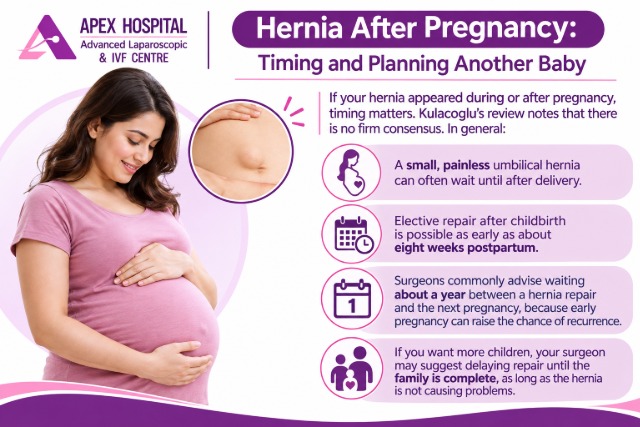
If your hernia appeared during or after pregnancy, timing matters. Kulacoglu’s review notes that there is no firm consensus. In general:
- A small, painless umbilical hernia can often wait until after delivery.
- Elective repair after childbirth is possible as early as about eight weeks postpartum.
- Surgeons commonly advise waiting about a year between a hernia repair and the next pregnancy, because early pregnancy can raise the chance of recurrence.
- If you want more children, your surgeon may suggest delaying repair until the family is complete, as long as the hernia is not causing problems.
This is a decision to make together with both your surgeon and your gynaecologist. If you are planning another pregnancy and want a joint plan, our obstetrics and gynaecology team can coordinate with surgery. It also helps to know the warning signs of a high-risk pregnancy if you have had previous abdominal surgery.
How to Lower Your Risk
You cannot control everything, but these steps help:
- Keep the C-section wound clean and report redness, discharge or fever early.
- Avoid heavy lifting in the first weeks after surgery.
- Treat chronic cough and constipation, because straining pushes against the scar.
- Work toward a healthy weight at your own pace.
- Return to core exercise gradually, ideally with guidance from a postpartum physiotherapist.
Frequently Asked Questions
Can a hernia appear years after a C-section?
Yes. Incisional hernias can develop months or even years later, which is why follow-up periods in studies run up to ten years.
Is a C-section hernia dangerous?
Not always. Many are slow and stable. But any hernia can become trapped, and that is an emergency.
Will a hernia go away on its own?
No. A true hernia does not heal without surgery, although diastasis recti can improve.
Can I have a normal delivery or another C-section with a hernia?
Often yes, but this depends on the hernia and your overall health. Please discuss it with your obstetrician and surgeon.
How long does hernia repair surgery take?
It varies with the size of the defect and the technique used. Your surgeon will give you an estimate after examining you.
Get It Checked, Don’t Wait It Out
A bulge near your C-section scar or belly button is worth a proper examination. Most hernias are straightforward to repair when found early, and waiting only makes the repair larger. To book a consultation with Dr. R.K. Mehta, call +91 9619642000 or use our online OPD booking.