
Same diagnosis. Same operation, technically. Completely different recovery.
That’s the gap between laparoscopic vs open surgery. And it’s usually what patients want to know before they want to know anything else about the procedure itself.
“Will I be home in two days or five? Back to work in two weeks or six?”
In this blog, Apex Hospital will compare laparoscopic vs open surgery recovery. Discussing times across the procedures where choice comes up most and explaining why the gap exists in the first place.
Let’s start.
Laparoscopic vs Open Surgery: What’s Actually Different
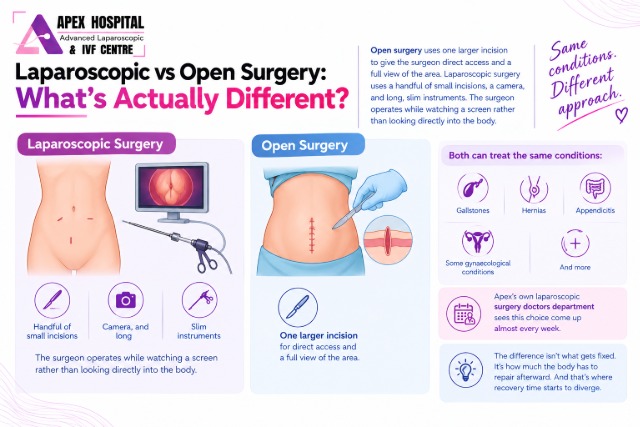
Open surgery uses one larger incision to give the surgeon direct access and a full view of the area. Laparoscopic surgery uses:
- Handful of small incisions
- Camera, and long
- Slim instruments
The surgeon operates while watching a screen rather than looking directly into the body. Both approaches can treat the same conditions – gallstones, hernias, appendicitis, some gynaecological conditions, more. Apex’s own laparoscopic surgery doctors department sees this choice come up almost every week.
The difference isn’t what gets fixed. It’s how much the body has to repair afterward. And that’s where recovery time starts to diverge.
Why Recovery Times Differ So Much
Three things drive the gap and they all trace back to incision size.
- Less tissue trauma: 1-2 cm incision heals faster and hurts less than 10-15 cm one. Less cutting means less inflammation and less pain signalling to manage.
- Lower infection risk: Smaller wounds mean less exposed tissue. Which usually means a lower chance of surgical site infection. One of the most common reasons hospital stays stretch longer than planned!
- Faster return of normal function: Open abdominal surgery disturbs more muscle and more of the gut’s normal movement, which is part of why bowel function and mobility come back slower after an open procedure.
None of this means laparoscopic surgery is automatically the better choice for every patient. It means that when both options are medically appropriate, recovery curve usually favours the smaller incisions.
Hospital Stay: Laparoscopic vs Open
This is where the data is most consistent across procedures.
- Gallbladder removal (cholecystectomy): Laparoscopic patients often go home within a day. Open cholecystectomy typically means 3-5 days in hospital. If you’re dealing with stones right now, our guide on gallbladder stone symptoms and surgery is worth reading first.
- Appendectomy: Laparoscopic appendectomy generally means a 1–2 day stay. Open appendectomy tends to run 2–4 days. This gap widens further for complicated or perforated appendicitis. Read what causes appendicitis to learn how decisions get made.
- Hernia repair: Both approaches often allow same-day or next-day discharge for straightforward cases, though laparoscopic repair usually comes with less post-operative pain. Not every hernia is treated the same way. Our piece on types of hernia breaks down the differences.
- Colorectal surgery: Laparoscopic resection has been shown to shorten total hospital stay by a couple of days compared with the open approach, in studies of colorectal cancer surgery.
Across procedure types, laparoscopic surgery tends to cut hospital stay by roughly one to three days compared with open surgery performed for the same condition.
Return to Normal Activity: Bigger Gap
Hospital discharge isn’t the same as feeling normal. This is where the difference between the two approaches really shows up.
Laparoscopic surgery
Most patients report feeling close to normal within two to three weeks. Light activity, including walking and basic daily tasks, often resumes within days. Driving and desk work are commonly cleared around the one to two week mark, depending on the procedure and the surgeon’s advice.
Here’s a detailed breakdown of recovery after laparoscopic gallbladder surgery. It’s a good example of what this timeline looks like day by day.
Open surgery
Full recovery from open abdominal surgery often takes four to six weeks, sometimes longer for major procedures. Lifting restrictions tend to last longer, since the abdominal wall itself needs more time to regain strength after a larger incision.
Return-to-work timelines follow the same pattern. Laparoscopic patients are frequently cleared for desk-based work within one to two weeks, while open surgery patients may need three to six weeks depending on how physical their job is.
Pain and Scarring
Pain management differs too. Laparoscopic patients typically need less post-operative pain medication, and several studies on procedures like fundoplication and hernia repair have found lower analgesic requirements in the laparoscopic group. Scarring follows the same logic: a few small marks versus one longer line. For patients who’ve had prior abdominal surgery or who care about cosmetic outcome, that’s often part of the conversation with their surgeon.
When Open Surgery Is Still the Right Call
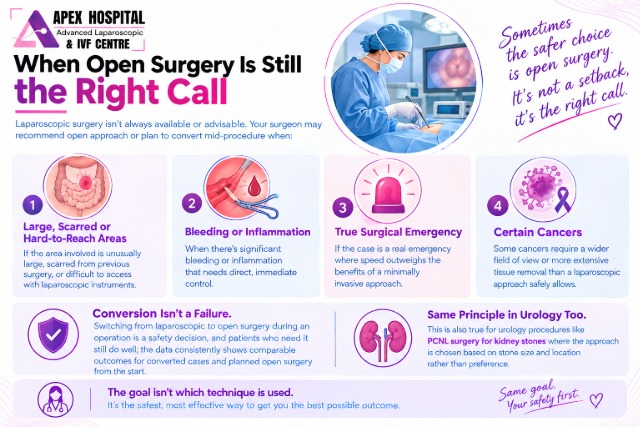
Laparoscopic surgery isn’t always available or advisable. Your surgeon may recommend open approach or plan to convert mid-procedure when:
- Area involved is unusually large, scarred from previous surgery, or difficult to access with laparoscopic instruments
- There’s significant bleeding or inflammation that needs direct, immediate control
- The case is a true surgical emergency where speed outweighs the benefits of a minimally invasive approach
- Certain cancers require a wider field of view or more extensive tissue removal than a laparoscopic approach safely allows
Conversion from laparoscopic to open surgery during an operation isn’t a failure. It’s a safety decision, and patients who need it still do well; the data consistently shows comparable outcomes for converted cases compared with planned open surgery from the start. This is also true for urology procedures like PCNL surgery for kidney stones where the approach is chosen based on stone size and location rather than preference.
What Determines Your Recovery Time
No two recoveries look identical. Yes, even with the same procedure. Real timeline depends on:
- Specific procedure and how complex it turns out to be
- Your overall health (including conditions like diabetes or obesity that can slow wound healing)
- Age since tissue repair naturally slows with age
- Whether complications occur such as infection or bleeding
- How closely post-operative instructions are followed. Especially around activity restrictions and wound care
A specialist who has reviewed your scans and history can give a timeline specific to you, not a generic range pulled from an average case.
Making the Decision: Questions Worth Asking Your Surgeon
Before any procedure, it helps to ask directly:
- Is my condition suitable for a laparoscopic approach or does it need to be open?
- What’s the realistic hospital stay for my specific case?
- When can I expect to return to light activity, driving, and work?
- What would make you switch to open surgery during the procedure?
- What complications am I more at risk for, given my health history?
A good surgical consultation answers these clearly, before you’re on the table. You can book one directly through Apex’s online consultation if an in-person visit isn’t possible right away.
Frequently Asked Questions About Laparoscopic vs Open Surgery
Is laparoscopic surgery always faster to recover from?
In most comparable cases, yes. But suitability depends on your specific condition, not personal preference alone.
Does a longer operation mean a harder recovery?
Not necessarily. Laparoscopic procedures often take slightly longer on the table but still lead to an easier, shorter recovery, because the incisions are smaller.
Can I request laparoscopic surgery even if my surgeon suggests open?
You can discuss it, but the final recommendation depends on medical safety, not preference. Some conditions genuinely need an open approach.
Is the risk of complications different between the two?
Both approaches carry risk, but laparoscopic surgery is generally associated with lower rates of wound infection. Risk profiles still depend heavily on the specific procedure.
How soon after laparoscopic surgery can I drive?
Often within one to two weeks, once pain is controlled and reflexes feel normal, but always confirm with your surgeon first.
Laparoscopic vs Open Surgery: Where This Leaves You
The laparoscopic vs open surgery decision usually isn’t really a decision you make yourself. It’s a recommendation your surgeon makes based on your:
- Condition
- Anatomy
- Health history.
What you can control is understanding what each path actually means for your recovery. So you can plan your time, work, and support at home accordingly.
Facing a procedure and want clarity on which approach fits your case? Call Apex Hospital, Sirsa on +91 9619642000 and talk to our surgical team directly.