Cryopreservation (Egg Freezing) in Haryana
Choosing when to start a family is a deeply personal decision. Whether you’re focused on your career, planning for the future, or facing a medical condition that may affect your fertility, egg freezing (cryopreservation) offers the opportunity to preserve your reproductive potential.
At Apex Hospital, Best IVF Centre in Haryana, we provide advanced egg freezing in Haryana using modern vitrification technology and personalized fertility care. Led by Dr. Manisha Mehta, our experienced fertility team helps women preserve healthy eggs today, giving them greater flexibility when planning for future pregnancies.
“Egg freezing empowers women with more reproductive choices. Our goal is to preserve fertility safely while providing compassionate guidance at every stage of the journey.”
– Dr. Manisha Mehta
When Should You See a Gynecologist?
Egg freezing can benefit women who wish to preserve their fertility before age-related decline or medical treatments that may affect ovarian function.
It may be recommended for:
Women planning to delay pregnancy for career, education, or personal reasons.
Women diagnosed with cancer before undergoing chemotherapy or radiation therapy.
Women with endometriosis may have an impact on ovarian reserve.
Women with a family history of premature menopause.
Women with reduced ovarian reserve who want to preserve the remaining healthy eggs.
Individuals preparing for gender-affirming medical treatments that may affect fertility.
Every woman’s fertility journey is different. A comprehensive fertility evaluation helps determine whether egg freezing is suitable for your individual circumstances.
Take control of your reproductive future. Book a consultation with Dr. Manisha Mehta to learn whether egg freezing is the right option for you.
The Egg Freezing Process – Step by Step
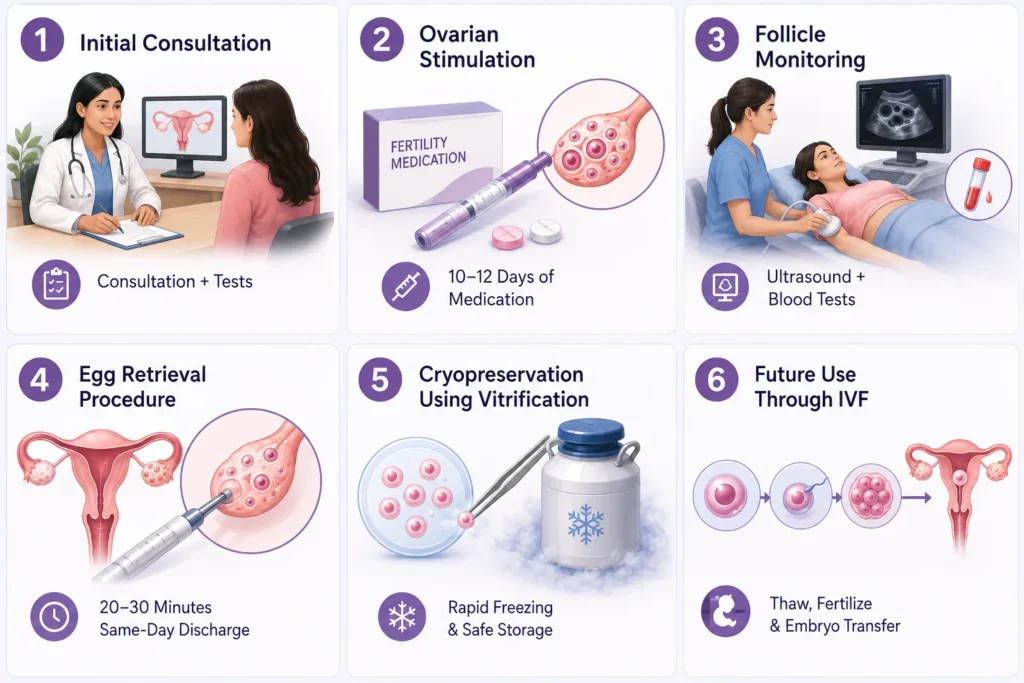
At Apex Hospital, the egg freezing process is carefully planned to ensure your comfort, safety, and the best possible outcomes. Here’s what you can expect throughout your fertility preservation journey.
1. Initial Fertility Consultation
Your journey begins with a detailed consultation with Dr. Manisha Mehta. We review your medical history, reproductive goals, menstrual cycle, and lifestyle. Blood tests and an ultrasound scan are performed to assess your ovarian reserve and determine the most suitable treatment plan.
2. Ovarian Stimulation
To increase the number of mature eggs available for freezing, fertility medications are prescribed for approximately 10 to 12 days. These medications encourage multiple follicles to develop during a single menstrual cycle.
3. Follicle Monitoring
Throughout the stimulation phase, you’ll have regular ultrasound scans and blood tests to monitor follicle growth and hormone levels. This allows our fertility specialists to determine the ideal time for egg retrieval.
4. Egg Retrieval Procedure
Once the eggs have matured, a trigger injection is given to prepare them for retrieval. Approximately 34 to 36 hours later, the eggs are collected using a minimally invasive transvaginal ultrasound-guided procedure under light sedation. The procedure usually takes about 20 to 30 minutes, and most women return home the same day.
5. Cryopreservation Using Vitrification
The retrieved mature eggs are immediately frozen using vitrification, an advanced rapid-freezing technique that minimizes ice crystal formation and helps preserve egg quality. The eggs are then stored safely in specialized cryogenic tanks until you decide to use them.
6. Future Use Through IVF
When you’re ready to start your family, the frozen eggs are thawed, fertilized with sperm in our IVF laboratory, and the resulting embryo is transferred into the uterus. This allows you to use eggs preserved at a younger age, when fertility potential is generally higher.
What Are the Benefits of Egg Freezing?
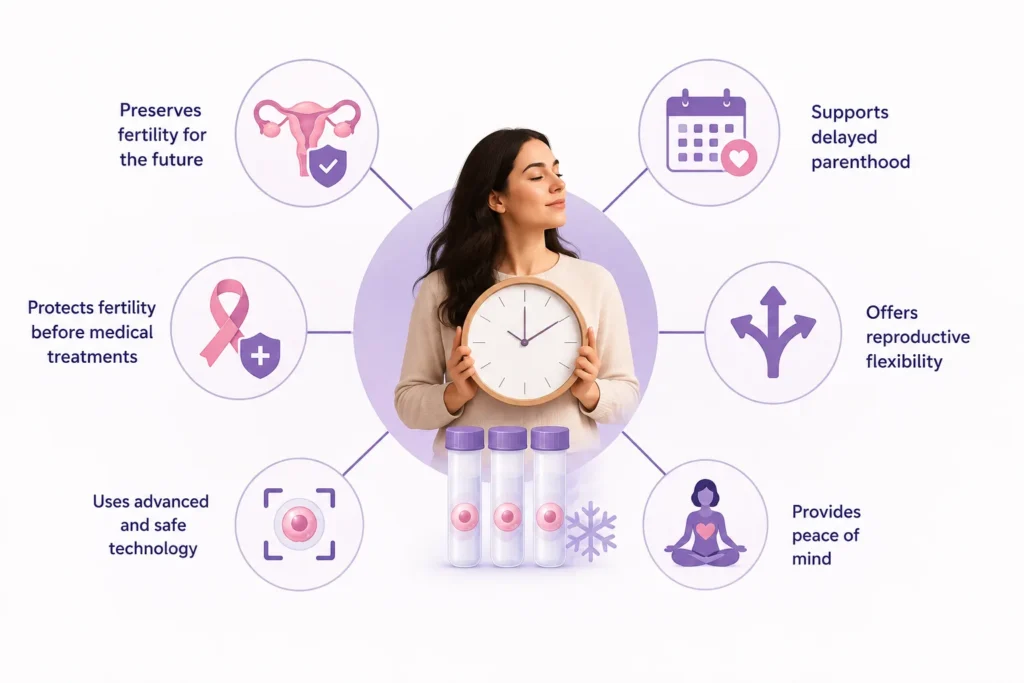
Egg freezing has become an increasingly popular fertility preservation option for women who want greater flexibility in planning their future. While it cannot guarantee pregnancy, it can significantly improve future reproductive options.
Some of the key benefits include:
Preserves fertility for the future
Protects fertility before medical treatments
Uses advanced and safe technology
Supports delayed parenthood
Offers reproductive flexibility
Provides peace of mind
It’s important to remember that while egg freezing improves future reproductive possibilities, the chances of pregnancy depend on factors such as your age at the time of freezing, the number of eggs stored, and your overall reproductive health.
What Is the Success Rate of Egg Freezing?
The success of egg freezing depends on several individual factors, particularly the woman’s age at the time the eggs are frozen. Generally, eggs retrieved and frozen before age 35 are more likely to result in a successful pregnancy.
While egg freezing cannot guarantee pregnancy, advancements in reproductive medicine have made it a reliable fertility preservation option for many women. During your consultation, our fertility specialists will evaluate your fertility profile and provide personalized guidance regarding your expected outcomes.
Cost of Egg Freezing in Haryana
Egg freezing has become an increasingly popular fertility preservation option for women who want greater flexibility in planning their future. While it cannot guarantee pregnancy, it can significantly improve future reproductive options.
Some of the key benefits include:
Initial fertility consultation and diagnostic tests
Egg retrieval procedure
Cryopreservation (vitrification) charges
Future IVF treatment when the frozen eggs are used
Fertility medications used for ovarian stimulation
Offers reproductive flexibility
Annual egg storage fees
At Apex Hospital, we believe in transparent pricing with no hidden charges. During your consultation, you’ll receive a personalized treatment plan along with a clear explanation of the expected costs.
Why Choose Apex Hospital for Egg Freezing in Haryana?
Choosing the right fertility centre is just as important as choosing the treatment itself. At Apex Hospital, we combine advanced reproductive technology with compassionate, individualized care to help women preserve their fertility with confidence.
Here’s why women across Haryana trust Apex Hospital:
Experienced fertility specialists led by Dr. Manisha Mehta
Advanced vitrification technology for optimal egg preservation
State-of-the-art IVF and embryology laboratory
Personalized fertility preservation plans based on your goals
High standards of safety, quality, and clinical excellence
Continuous support from consultation to future IVF treatment

Whether you’re planning for the future or preserving fertility before medical treatment, our experienced team is committed to providing expert care at every stage of your journey.
FAQs
The best time to freeze eggs is generally before the age of 35, when egg quality and quantity are typically higher. However, the procedure may still be beneficial depending on your individual fertility assessment.
Frozen eggs can remain safely stored for many years without a significant loss in quality when maintained under proper cryopreservation conditions.
Most women experience only mild discomfort during ovarian stimulation. Egg retrieval is performed under sedation, making the procedure generally comfortable.
The number varies depending on your age and ovarian reserve. Your fertility specialist will recommend an appropriate number based on your individual circumstances and future pregnancy goals.
No. Egg freezing improves your future reproductive options but cannot guarantee pregnancy. Success depends on factors such as your age at freezing, egg quality, and overall reproductive health.
Egg freezing is considered a safe procedure. Some women may experience temporary bloating, mild cramping, or discomfort from fertility medications, but serious complications are uncommon.