“Doctor, is PCOS the same as PCOD?” It’s one of the most common questions asked in a gynaecology clinic. And honestly, a fair one. The two terms get used interchangeably in casual conversation, on prescriptions, and even sometimes between doctors. But they aren’t quite the same thing. Yes, the conversation just got an important update!
In this blog, Apex Hospital will tell you everything about PCOS and PCOD.
PCOS Was Just Renamed PMOS: Here’s Why That Matters First
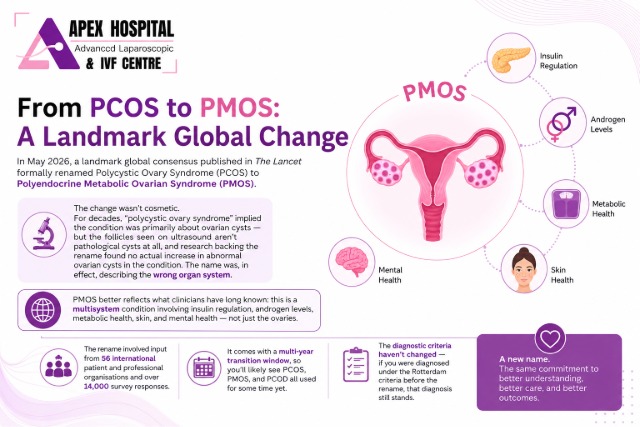
In May 2026, a landmark global consensus published in The Lancet formally renamed Polycystic Ovary Syndrome (PCOS) to Polyendocrine Metabolic Ovarian Syndrome (PMOS). The change wasn’t cosmetic. For decades, “polycystic ovary syndrome” implied the condition was primarily about ovarian cysts — but the follicles seen on ultrasound aren’t pathological cysts at all, and research backing the rename found no actual increase in abnormal ovarian cysts in the condition. The name was, in effect, describing the wrong organ system.
PMOS better reflects what clinicians have long known: this is a multisystem condition involving insulin regulation, androgen levels, metabolic health, skin, and mental health — not just the ovaries. The rename involved input from 56 international patient and professional organisations and over 14,000 survey responses, and it comes with a multi-year transition window, so you’ll likely see PCOS, PMOS, and PCOD all used for some time yet. The diagnostic criteria haven’t changed — if you were diagnosed under the Rotterdam criteria before the rename, that diagnosis still stands.
So What Is PCOD Really?
Here’s where a lot of the confusion actually comes from: PCOD isn’t a formally defined international medical diagnosis the way PCOS/PMOS is. It’s a term used widely — especially in India — to describe a milder, more lifestyle-linked pattern of ovarian cysts and irregular cycles, without necessarily meeting the full diagnostic bar for the syndrome.
PCOS/PMOS, by contrast, is diagnosed using the Rotterdam criteria — a globally standardised framework requiring at least two of three specific findings: irregular or absent ovulation, clinical or biochemical signs of excess androgens, and polycystic ovarian morphology on ultrasound, after other causes have been ruled out. PCOD has no equivalent formal criteria — which is exactly why the same patient might be told she has “PCOD” by one doctor and “PCOS” by another.
PCOS/PMOS vs PCOD: The Real Difference
| PCOD | PCOS / PMOS | |
|---|---|---|
| Formal diagnostic criteria | None internationally standardised | Rotterdam criteria (2 of 3: anovulation, hyperandrogenism, polycystic ovarian morphology) |
| Typical severity | Often milder, more lifestyle-responsive | Ranges mild to severe; broader metabolic and endocrine involvement |
| Underlying nature | Descriptive term for a symptom pattern | Recognised endocrine and metabolic syndrome |
| Long-term health risks | Generally lower if managed early | Linked to insulin resistance, type 2 diabetes risk, cardiovascular risk |
| Fertility impact | Variable, often manageable with lifestyle change | Frequently requires medical management for ovulation |
Why This Distinction Actually Affects Your Treatment
This isn’t just semantics. It changes what a treatment plan actually needs to cover.
- A patient with a PCOD-type presentation (mild irregularity, no significant hyperandrogenism, normal metabolic markers) may respond well to dietary changes, exercise, and cycle regulation alone
- A patient meeting full PCOS/PMOS criteria typically needs a broader workup — insulin resistance screening, androgen levels, and a treatment plan that addresses metabolic health alongside reproductive symptoms, not just the irregular cycles
- Fertility treatment differs too: anovulatory PCOS/PMOS often needs ovulation induction or IUI as a first step, while some PCOD presentations resolve with lifestyle changes before any medical intervention is needed
- Patients undergoing IVF with PCOS/PMOS also carry a higher risk of ovarian hyperstimulation, which is why stimulation protocols need to be individualised — something we’ve covered in more depth in our piece on hyperstimulation
Getting labelled with the “wrong” term isn’t dangerous by itself — but getting treated based on the wrong underlying assumption can mean months of a treatment plan that was never addressing the actual issue.
Symptoms Checklist: When to Get Evaluated
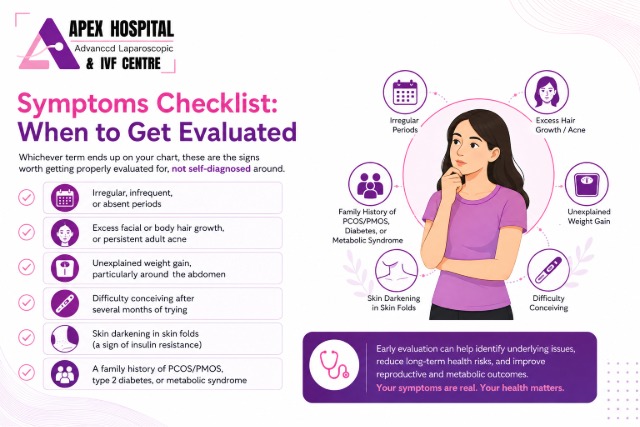
Whichever term ends up on your chart, these are the signs worth getting properly evaluated for, not self-diagnosed around:
- Irregular, infrequent, or absent periods
- Excess facial or body hair growth, or persistent adult acne
- Unexplained weight gain, particularly around the abdomen
- Difficulty conceiving after several months of trying
- Skin darkening in skin folds (a sign of insulin resistance)
- A family history of PCOS/PMOS, type 2 diabetes, or metabolic syndrome
It’s also worth ruling out conditions that mimic these symptoms — endometriosis, for instance, causes its own pattern of pelvic pain and fertility difficulty, covered in our guide on how endometriosis is diagnosed.
How PCOS/PMOS and PCOD Are Treated at Apex Hospital
At Apex, the starting point is never the label on a previous prescription — it’s a proper workup: hormone levels, ultrasound, and a metabolic screen where indicated, under our Obs & Gynae department. From there, treatment is built around what’s actually driving the symptoms:
- Lifestyle and dietary management for milder, PCOD-type presentations
- Ovulation induction or IUI for patients trying to conceive with anovulatory cycles
- Laparoscopic ovarian drilling in select, medically appropriate cases where medical management alone hasn’t restored ovulation — part of our broader laparoscopic surgery programme
- IVF, with individualised stimulation protocols, for patients who need it — with transparent guidance on what that path actually costs, covered in our IVF cost breakdown
Frequently Asked Questions
Is PCOD the same as PCOS?
Not exactly. PCOD is a widely used but informal term, often describing a milder pattern, while PCOS (now PMOS) is a formally diagnosed endocrine syndrome based on the Rotterdam criteria.
Why was PCOS renamed to PMOS?
Because “polycystic ovary syndrome” wrongly implied pathological ovarian cysts and understated that the condition affects insulin, hormones, and metabolic health well beyond the ovaries — a global consensus published in The Lancet in May 2026 formalised the new name.
Does the name change affect my existing PCOS diagnosis or treatment?
No. If you were diagnosed under the Rotterdam criteria, that diagnosis still stands — the name has changed, not the underlying diagnostic criteria or your treatment plan.
Can PCOD turn into PCOS/PMOS over time?
The two aren’t stages of the same disease in a strict clinical sense, but a milder presentation can evolve, or turn out on closer evaluation to already meet full PCOS/PMOS criteria — which is why re-evaluation matters if symptoms change.
Does PCOS/PMOS always affect fertility?
Not always, but it’s a leading cause of anovulatory infertility. Many patients conceive with ovulation induction or IUI; some need IVF depending on severity and other factors.
What tests confirm a PCOS/PMOS diagnosis?
Typically a hormone panel (including androgens), an ultrasound to assess ovarian morphology, and a review of cycle regularity — evaluated together against the Rotterdam criteria, not any single test alone.
Is weight loss enough to manage PCOD or PCOS/PMOS?
For milder, PCOD-type presentations, lifestyle changes alone are often effective. For more significant PCOS/PMOS with insulin resistance or hyperandrogenism, medical management alongside lifestyle change is usually needed.
Should I ask my doctor whether I have PCOD or PCOS/PMOS specifically?
Yes — the label matters less than the underlying workup, but understanding which pattern you fall into helps set expectations for treatment, monitoring, and long-term health risks like diabetes.
PCOS and PCOD: Where This Leaves You
The label on your chart matters less than what’s actually driving your symptoms — and that only comes from a proper hormonal and metabolic workup, not a name alone. Whether it turns out to be a mild, lifestyle-responsive pattern or the broader syndrome now known as PMOS, getting evaluated properly is what actually changes your treatment path.
Concerned about irregular cycles or a PCOS/PCOD diagnosis? Book a consultation with Dr. Manisha Mehta, or call us at 9619642000