
Sharp pain. Sudden. Back, side, groin. Then the scan report lands, and one number matters more than the rest: kidney stone size. 5 mm. Or 8 mm. Or 14 mm.
That number steers everything. A 4 mm stone often leaves on its own. A 9 mm stone rarely does. And a stone over 2 cm needs a completely different plan.
This guide from Apex Hospital – highly known for laparoscopic surgery Sirsa – gives you a clear kidney stone chart, in millimetres. You’ll see which stones pass, which need a little help, and when PCNL or URS becomes the right call. No jargon. Just the numbers, and what they mean for you.
Why Kidney Stone Size Decides So Much
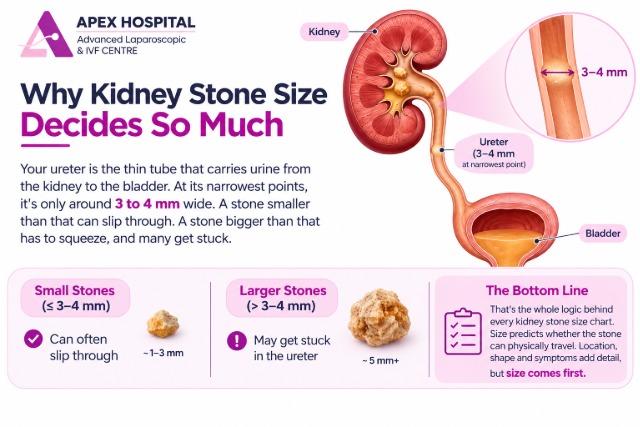
Your ureter is the thin tube that carries urine from the kidney to the bladder. At its narrowest points, it’s only around 3 to 4 mm wide. A stone smaller than that can slip through. A stone bigger than that has to squeeze, and many get stuck.
That’s the whole logic behind every kidney stone size chart. Size predicts whether the stone can physically travel. Location, shape and symptoms add detail, but size comes first.
Kidney Stone Size Chart: What Passes and What Doesn’t
One of the largest CT-based studies on this, a study of 392 ureteral stones, tracked how often stones passed by size. Here’s a simplified version in everyday terms:
| Stone size | Looks like | Chance of passing alone | What usually happens |
| Up to 3 mm | Grain of rice | Very high (about 98%) | Fluids and pain relief. Usually passes in days. |
| 4 mm | Peppercorn | About 80% | Usually passes, though it may hurt on the way. |
| 5 mm | Small pea | About 65% | A trial of passing, often with medication your doctor prescribes. |
| 6 mm | Pencil eraser | About 1 in 3 | Often needs help, especially if it’s high up. |
| 7–9 mm | Chickpea | Low (under 10% beyond 6.5 mm) | Usually needs a procedure, most often URS. |
| 10–20 mm | Marble to large grape | Very unlikely | Needs treatment. The method depends on location. |
| Over 20 mm | Bigger than a ₹1 coin | Will not pass | Typically PCNL. |
A few honest caveats. These percentages come from stones sitting in the ureter, and they’re averages. Your own odds depend on the factors below. If you see a different actual kidney stone size chart online with slightly different figures, that’s normal, because studies measure different groups.
A quick note on mm vs cm
Reports mix units, and it trips up a lot of people. Ten millimetres make one centimetre. So 6 mm is 0.6 cm, and 1.2 cm is 12 mm. Always check which unit your report uses before you worry or relax.
Size Isn’t the Whole Story
Two 6 mm stones can behave very differently. Here’s why.
Location. A stone low in the ureter, close to the bladder, passes more easily than the same stone high up near the kidney. A stone still sitting inside the kidney itself may stay put for years and cause no trouble.
Shape and type. Stones with rough, spiky edges cause more damage on the way down. Harder stones are also less likely to pass. Our guide on kidney stone types, symptoms and causes explains how types differ. Struvite stones deserve a special mention, since they grow quickly and are linked to infection. Our blog on struvite stones covers why they rarely resolve without treatment.
Symptoms. A small stone with fever is more urgent than a bigger stone with mild discomfort. Size is a guide, not a verdict.
What to Do While You Wait for a Stone to Pass
If your stone is small and your symptoms are controlled, your doctor may suggest waiting, usually four to six weeks at most. During that time:
- Drink plenty of water. Aim for pale urine throughout the day.
- Use pain relief as prescribed. Don’t guess at doses.
- Take medication your doctor recommends. Some drugs relax the ureter and help stones pass, but only your doctor should decide on them.
- Strain your urine if asked, so the stone can be analysed.
- Skip the folk remedies. Beer, lemon juice and cranberry juice won’t dissolve a stone. Our post on kidney and gallbladder stone myths separates fact from fiction.
Waiting only works if nothing else goes wrong. Which brings us to the warning signs.
When a Kidney Stone Needs Surgery
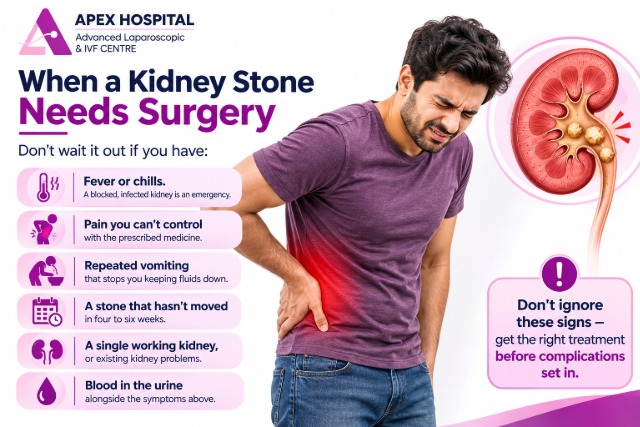
Don’t wait it out if you have:
- Fever or chills. A blocked, infected kidney is an emergency.
- Pain you can’t control with the prescribed medicine.
- Repeated vomiting that stops you keeping fluids down.
- A stone that hasn’t moved in four to six weeks.
- A single working kidney, or existing kidney problems.
- Blood in the urine alongside the symptoms above.
Our list of signs you need kidney stone surgery walks through these in more detail. If any of them apply, go to the hospital rather than waiting for the next appointment.
PCNL vs URS: Which Procedure for Which Stone?
Both clear stones. They suit different situations, and the size chart above is the starting point for choosing between them.
URS (ureteroscopy)
A thin telescope goes up through the urinary passage. No cut is needed. A laser breaks the stone into fragments, and a temporary stent may be placed afterward. It’s the usual choice for stones stuck in the ureter and for small to medium stones in the kidney. Recovery is quick, and most people are back to routine within days. You can read more about URS ureteroscopy at Apex.
PCNL (percutaneous nephrolithotomy)
For stones that are too big for URS, usually over 2 cm, PCNL is the go-to. A small incision in the back creates a direct tunnel into the kidney, and the stone is broken up and removed. It also suits very hard stones and large branching ones. The hospital stay is a little longer, but one session often clears the whole stone. Here’s more on PCNL surgery for kidney stones.
What about shockwave lithotripsy?
Some stones in the middle range can also be treated with shockwaves from outside the body. Whether that works depends on stone hardness, position and your anatomy. Your urologist will tell you which option fits best, and our urologists in Sirsa can walk you through the choice after reviewing your scan.
Frequently Asked Questions About Kidney Stone Size
What size kidney stone can pass on its own?
Stones up to about 4 mm usually pass. Stones from 5 to 6 mm are a gray zone. Beyond 7 mm, passing alone becomes unlikely.
Is a 5 mm kidney stone big?
It’s small, but it sits close to the tipping point. Many pass, though a good share need help, depending on location.
How long can I wait for a stone to pass?
Usually no more than four to six weeks, and only if pain is controlled and there’s no fever. Longer blockage can harm the kidney. The American Urological Association’s guidance on ureteral stones explains why size and symptoms guide that decision.
Does a bigger stone always mean more pain?
No. Small stones that get stuck can hurt badly, while large stones inside the kidney can be silent.
Which size needs PCNL?
Typically stones above 2 cm, or very large or branching ones. Smaller stones are usually handled with URS or other methods.
Kidney Stone Size Chart: Where This Leaves You
A kidney stone size chart gives you a map, not a promise. Small stones under 4 mm usually leave on their own. Mid-sized ones in the 5 to 6 mm range are a judgement call. Anything beyond 7 mm usually needs help, and stones over 2 cm are PCNL territory. But your location, symptoms and scan details matter just as much as the number on the report. So don’t diagnose yourself from a table, and don’t wait out a fever or uncontrolled pain. If you’ve just received a scan report and aren’t sure what it means, call Apex Hospital, Sirsa on +91 91680 39000, or book through Online OPD, and get a clear plan for your stone.