You’ve been trying for months. Maybe longer. Now the doctor says “IUI” or “IVF” and suddenly it’s 2 AM and you’re googling.
Here’s the thing about IUI vs IVF. It’s not about which one is better. It’s about which one fits your body, your age and your diagnosis. One is a gentle nudge. The other is a full workaround. Pick the wrong one and you lose months, money and a lot of hope.
So let’s break it down. Apex Hospital – home to best infertility doctors in Sirsa – will tell you what each treatment does, who it suits, and the signs that it’s time to move from one to the other.
What Is the Real Difference Between IUI and IVF?
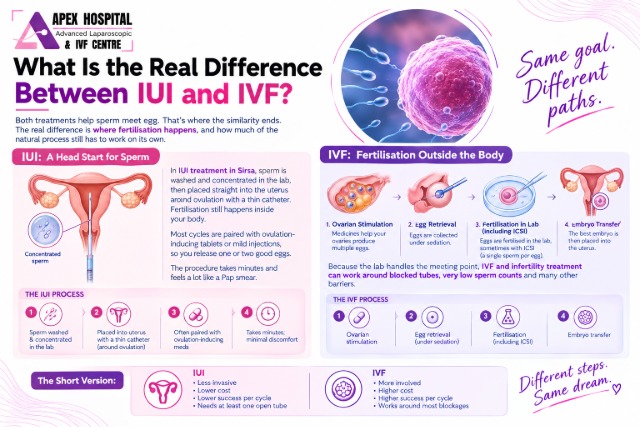
Both treatments help sperm meet egg. That’s where the similarity ends. The real difference is where fertilisation happens, and how much of the natural process still has to work on its own.
IUI: a head start for sperm
In IUI treatment in Sirsa, sperm is washed and concentrated in the lab, then placed straight into the uterus around ovulation with a thin catheter. Fertilisation still happens inside your body. Most cycles are paired with ovulation-inducing tablets or mild injections, so you release one or two good eggs. The procedure takes minutes and feels a lot like a Pap smear.
IVF: fertilisation outside the body
IVF skips the guesswork. Medicines stimulate the ovaries to produce several eggs, which are retrieved under sedation and fertilised in the lab. Sometimes a single sperm is injected into each egg, a method called ICSI. The best embryo is then transferred to the uterus. Because the lab handles the meeting point, IVF and infertility treatment can work around blocked tubes, very low sperm counts and many other barriers.
The short version:
- IUI: less invasive, lower cost, lower success per cycle, needs at least one open tube
- IVF: more involved, higher cost, higher success per cycle, works around most blockages
IUI vs IVF Success Rates: What Do the Numbers Actually Say?
Let’s be honest here, because this is where most confusion starts. IUI is gentler. IVF is stronger. Neither is a guarantee.
Per-cycle pregnancy rates for IUI usually sit around 10–20% when the couple is well matched to the treatment, and they fall with age. IVF per-cycle rates are considerably higher. Figures of roughly 40–50% are commonly quoted for women under 35, and those fall with age too. ReproductiveFacts – patient education site of the American Society for Reproductive Medicine – makes the point that both can help you grow your family. Which one does depends on your diagnosis.
But per-cycle numbers aren’t the whole story. IVF isn’t “better” if your only problem is irregular ovulation that a tablet and IUI can fix. And IUI isn’t “cheaper” if you burn through six cycles that were never going to work. Rates vary a lot by clinic, age and cause, so ask your doctor for figures that apply to you, not headline averages.
When Is IUI Usually the Right First Step?
IUI works best when the basic plumbing is fine and the problem is subtle, or fixable with a little help. It’s a sensible starting point if you have:
- Unexplained infertility. All tests come back normal, especially if you’re under 35.
- Ovulation problems. Irregular cycles or PCOS, where medication brings back regular ovulation. Not sure if it’s PCOS or PCOD? Our blog on PCOS and PCOD differences explains why the label matters for treatment.
- Mild male factor. Slightly low count or motility, but a decent count after washing.
- Timing or cervical issues. Mucus problems, or difficulty with intercourse.
- Donor sperm use.
Now the non-negotiables. IUI needs at least one open fallopian tube, regular ovulation (natural or induced) and enough healthy sperm after washing. If any of those is missing, IUI isn’t a “gentler option.” It’s just the wrong tool.
When Does IVF Make More Sense From the Start?
Sometimes going straight to IVF isn’t aggressive. It’s efficient. Here’s where trying IUI first mostly delays the inevitable.
Blocked tubes or advanced endometriosis
IUI needs sperm and egg to meet inside a working tube. If both tubes are blocked or damaged, that meeting can’t happen. Endometriosis can also scar the pelvis and affect egg quality. If that sounds familiar, read our guide on how endometriosis is diagnosed and treated.
Severe male factor
When sperm count or motility is very low, washed sperm isn’t enough for IUI. IVF with ICSI needs just one healthy sperm per egg. If there’s no sperm in the semen at all, TESA and PESA can retrieve it directly from the testes or epididymis. Men are part of the story far more often than people admit. Our page on male infertility is a good place to start if that’s a concern.
Age and ovarian reserve
Egg quantity and quality drop with age, and that changes the math. For women in their late 30s, or those with low ovarian reserve, spending months on low-odds IUI cycles can eat into the window that matters most.
Other signals
- Three or four IUI cycles without success
- A need for genetic testing of embryos (PGT)
- Previous tubal surgery or tubal ligation
Which Tests Decide the Answer?
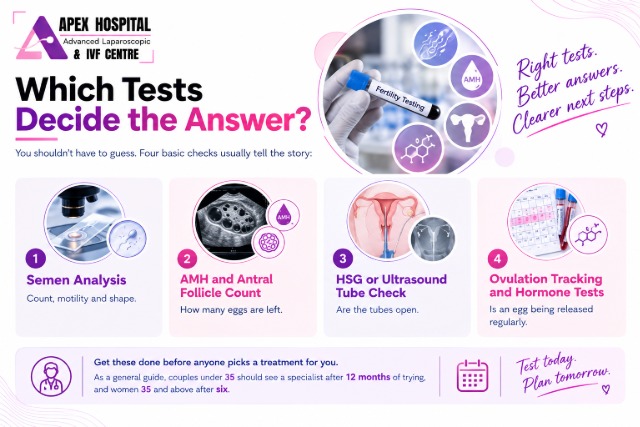
You shouldn’t have to guess. Four basic checks usually tell the story:
- Semen analysis: count, motility and shape
- AMH and antral follicle count: how many eggs are left
- HSG or ultrasound tube check: are the tubes open
- Ovulation tracking and hormone tests: is an egg being released regularly
Get these done before anyone picks a treatment for you. As a general guide, couples under 35 should see a specialist after 12 months of trying, and women 35 and above after six.
How Many IUI Cycles Are Too Many?
Nobody warns you about this one. Cumulative success from IUI tends to flatten after three or four cycles. More attempts add very little while cost and stress keep stacking up.
The ASRM guideline on unexplained infertility backs a stepwise approach. It notes that three cycles of oral-medication IUI followed straight by IVF can get to pregnancy sooner, and at lower cost, than adding extra rounds of injectable-medication IUI in between. Most doctors reassess after three cycles, sooner if you’re older. Decide that checkpoint before you start, not after the third heartbreak.
IUI vs IVF: Cost, Risks and Emotional Load
Money matters, and pretending it doesn’t helps nobody. One IUI cycle costs a fraction of one IVF cycle. But cost per baby is the fairer yardstick than cost per cycle. If you’d need four IUI cycles to match one IVF attempt’s odds, the price gap shrinks fast. Our IVF cost breakdown for Sirsa shows what a cycle typically includes.
Risks differ too. IUI with strong stimulation can lead to twins or higher multiples. IVF carries its own risks, like ovarian hyperstimulation, and multiples if more than one embryo is transferred. Single embryo transfer keeps that in check.
Then there’s the emotional side. IUI feels lighter. IVF feels bigger: injections, scans, retrieval, waiting. Neither is easy. A good clinic prepares you for both.
Frequently Asked Questions About IUI vs IVF
Is IVF always more successful than IUI?
Per cycle, generally yes. But only when the treatment matches the cause. For ovulation problems or mild issues, IUI can work very well.
Can we skip IUI and go straight to IVF?
Yes. Blocked tubes, severe male factor, low ovarian reserve or advanced age are common reasons. Your doctor decides after the basic tests.
How many IUI cycles should we try before switching?
Usually three to four, and fewer if you’re older or if tests already show a lower chance.
Is IUI painful?
Most women feel mild cramping, similar to a Pap smear. No anaesthesia is needed.
Is IVF only for couples who’ve failed everything else?
No. That’s a myth. For some diagnoses, IVF is the first and best option.
IUI vs IVF: Where This Leaves You
The IUI vs IVF decision comes down to three things: your diagnosis, your age and your timeline. IUI is a smart first step when the tubes are open, ovulation can be managed and sperm quality is decent. IVF is the smarter route when something is physically blocking the way, or when time is the thing you can’t afford to lose.
Don’t choose from a forum thread. Get the tests, ask for numbers that apply to your case and set a checkpoint for switching.
Wondering which side of the line you fall on? Call Apex Hospital, Sirsa on +91 9619642000 and sit down with a fertility specialist who’ll look at your reports, not a template.