IVF day by day starts with a simple signal. Day 1. Your period begins. Calendar marked. Clinic called. Injections ordered.
If you’re searching for an IVF timeline day by day, you probably want one thing. Clarity. What happens on which day? What will it feel like? When do you finally find out?
This blog from Apex Hospital and IVF Centre will walk you through one full IVF cycle in order. From the first day of your period, through scans, injections, egg retrieval and embryo transfer, to the pregnancy test. Timings vary between clinics and between people. But the shape stays the same. Here it is, step by step.
![Fertility specialist explaining the IVF cycle day by day to a couple at Apex Hospital Sirsa]
IVF Timeline Day by Day: The Big Picture
A typical fresh cycle takes about four to six weeks from the first injection to the pregnancy test. Here’s the map before we zoom in:
| When | What happens |
| Day 1 | Period starts. You call the clinic. |
| Day 2–3 | Baseline scan and blood tests. Injections begin. |
| Day 5–6 onward | Scans every two to three days. Extra medicine prevents early ovulation. |
| Around Day 10–14 | Trigger shot, timed to the hour. |
| 36 hours later | Egg retrieval. |
| Next morning | Fertilisation check. |
| Day 3 or Day 5 after retrieval | Embryo transfer (or embryos are frozen). |
| 10–14 days after transfer | Pregnancy test. |
Your doctor’s calendar always overrides this table. Protocols differ, and some start with weeks of medicine before stimulation. The NHS describes one such longer route, where your natural cycle is switched off first.
Before Day 1: Tests and Planning
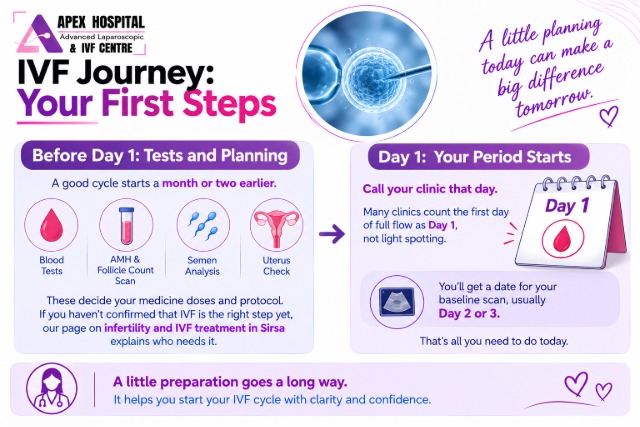
A good cycle starts a month or two earlier. Expect blood tests, an ovarian reserve check (AMH and a follicle count scan), semen analysis, and often a look at the uterus. These decide your medicine doses and protocol. If you haven’t confirmed that IVF is the right step yet, our page on infertility and IVF treatment in Sirsa explains who needs it.
Day 1: Your Period Starts
Call your clinic that day. Many clinics count the first day of full flow as Day 1, not light spotting. You’ll get a date for your baseline scan, usually Day 2 or 3. That’s all you need to do today.
Day 2–3: Baseline Scan and First Injection
A transvaginal ultrasound checks that your ovaries are quiet and your uterine lining is thin. Blood tests check your hormone levels. If everything looks right, you start daily hormone injections, usually for eight to fourteen days. They encourage several follicles to grow instead of the usual one. Most people learn to give the injections themselves within a day or two, and a nurse will show you how.
Day 4–12: Injections and Monitoring
This is the longest stretch, and the most routine. Every two to three days, you’ll have a scan and blood test so your doctor can see how many follicles are growing and adjust your dose. Around Day 5 or 6, a second medicine is often added to stop your body ovulating early.
What you might feel: bloating, mild pelvic heaviness, mood swings, tiredness. Severe pain, rapid weight gain or breathlessness aren’t normal. Call your clinic straight away, because they can signal ovarian hyperstimulation.
Trigger Day: The Most Time-Sensitive Injection
When your leading follicles reach about 17 to 18 mm, you take the trigger shot. It finishes maturing the eggs. The timing is exact. Your clinic will give you a time to the half hour, because egg retrieval must happen about 36 hours later, not before and not after.
Egg Retrieval Day
You’ll fast beforehand and be sedated. A thin needle, guided by ultrasound, collects the fluid from each follicle, and the embryologist finds the eggs in it. The procedure takes about 15 to 20 minutes, and you’ll usually go home within a few hours. Expect cramping and light spotting for a day or two.
The same day, your partner provides a semen sample. If no sperm are found in the sample, sperm can sometimes be collected by TESA or PESA. From the evening of retrieval, you’ll usually start progesterone support to prepare the uterine lining.
The Morning After: Fertilisation Report
The lab calls the next day with a number: how many eggs were mature, and how many fertilised. Not every egg makes it, and that’s normal. Fertilisation happens in one of two ways. In standard IVF, eggs and sperm are placed together. When sperm quality is a concern, a single sperm is injected into each egg. Our guide on ICSI explains when that’s chosen.
Day 1 to Day 5 After Retrieval: Embryos in the Lab
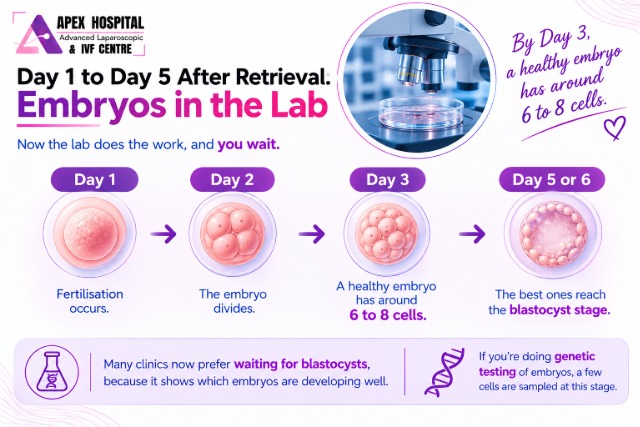
Now the lab does the work, and you wait. By Day 3, a healthy embryo has around 6 to 8 cells. By Day 5 or 6, the best ones reach the blastocyst stage. Many clinics now prefer waiting for blastocysts, because it shows which embryos are developing well. If you’re doing genetic testing of embryos, a few cells are sampled at this stage.
Embryo Transfer Day
Transfer is usually quick and gentle. A speculum is placed as in a Pap smear, and a thin catheter places the embryo into the uterus under ultrasound. No sedation is needed. It takes minutes, and you can usually go home soon after.
Not every embryo is transferred right away. Some cycles are “freeze-all,” where embryos are frozen and transferred in a later cycle, often to protect against hyperstimulation or to give the lining time to be ideal. If that’s your plan, the timeline stretches by a few weeks. Our blog on frozen blastocyst transfer explains what that cycle looks like.
The Two-Week Wait
Hardest part. Nothing to do, and no way to rush it. Symptoms in this window, like cramping, tender breasts or fatigue, aren’t reliable either way, because the progesterone you’re taking causes many of them.
Clinics usually test 10 to 14 days after transfer, with a blood test for the pregnancy hormone. NHS Inform gives the same range. Testing earlier at home can give a false negative, or a confusing result from the trigger shot. If the result is positive, a scan a few weeks later confirms that the pregnancy is in the right place and developing. For a broader picture of odds, our post of IVF facts and infertility stats puts the numbers in context.
What About the Cost?
A cycle includes more than injections and the procedure: scans, lab work, embryo culture, freezing and transfer all add up. Our IVF cost breakdown for couples in Sirsa explains what’s usually included, so you can ask the right questions at your first consultation.
Frequently Asked Questions About IVF Day by Day
How long does one IVF cycle take?
About four to six weeks from the first injection to the pregnancy test for a fresh cycle. A frozen transfer adds a few weeks.
Is egg retrieval painful?
You’re sedated, so you won’t feel it. Cramping and light bloating afterwards are common and usually settle within a day or two.
Do I need bed rest after embryo transfer?
No. Gentle normal activity is fine. Your clinic will tell you what to avoid, such as heavy lifting or strenuous exercise.
When can I take a home pregnancy test?
Wait for your clinic’s date. Testing too early can mislead you, partly because the trigger shot can linger in your system.
Do I definitely need IVF, or could IUI work first?
It depends on your tubes, sperm quality, age and ovarian reserve. IUI treatment suits some couples, while others are better off going straight to IVF.
IVF Day by Day: Where This Leaves You
An IVF cycle looks huge from the outside. Broken into days, it isn’t. A scan here. An injection there. One short procedure. A few days of waiting while the lab does its work. Then a test, and an answer. Your own IVF timeline day by day will differ a little from this one, depending on your age, hormones and protocol. That’s normal. What matters is a team that explains each step before it happens, so nothing feels like a surprise. If you’re planning a cycle, or just want to understand your options first, call Apex Hospital, Sirsa on +91 9619642000, or book through Online OPD, and get a calendar built around you.