
Surrogacy in India isn’t simple. It’s legal but tightly regulated. Only certain couples qualify. Only certain women can carry. And almost every step needs a certificate before the next one begins.
Apex Hospital, Sirsa recently registered under Surrogacy (Regulation) Act, and launched surrogacy services to support North Indian couples, families, and individuals with the same. In this blog, we will cover what we have been asked in the recent week, namely:
When is surrogacy actually needed?
Who is eligible for surrogacy services?
How does the surrogacy work?
And what should you ask any surrogacy clinic before you say yes?
Let’s start.
What Is Surrogacy?
In gestational surrogacy, an embryo is created through IVF and placed in the uterus of another woman – surrogate – who carries the pregnancy. She doesn’t use her own egg. A baby is born to intending parents and law treats the child as their biological child with all the same rights. That’s laid out in Section 8 of the Act.
So surrogacy is built on top of IVF. New to the idea of IVF? Our page on infertility and IVF treatment explains the medical groundwork.

Is Surrogacy Legal in India?
Yes but only in one form. The Surrogacy (Regulation) Act, 2021 allows altruistic surrogacy and bans commercial surrogacy. In practical terms, surrogates can’t be paid for carrying the baby. Only things that can be covered are her medical expenses and insurance.
Clinics offering surrogacy must also be registered with the appropriate authority. Apex Hospital recently registered, and received a license for rendering surrogacy services.
When is Surrogacy Needed?
Surrogacy isn’t a lifestyle choice. Law requires a medical indication that makes carrying a pregnancy impossible or unsafe. And the District Medical Board has to certify it. The usual reasons include:
- No uterus or abnormal one. This covers women born without a uterus (such as MRKH syndrome) and uteruses that are very small, scarred or misshapen.
- removed uterus. Often after cancer or severe bleeding. Our guide on hysterectomy types and treatment options explains why it’s sometimes unavoidable.
- Repeated IVF failure. When good embryos fail to implant after multiple IVF or ICSI attempts, doctors call it recurrent implantation failure.
- Multiple pregnancy losses. Especially when no cause can be found or fixed. If you’ve been through this, our blog on early pregnancy failure covers the causes.
- A health condition that makes pregnancy dangerous. Some heart, kidney or other illnesses put the woman’s life at risk.
If none of these apply, the law doesn’t allow surrogacy.
Surrogacy Eligibility Criteria in India
The rules are specific. Here’s who qualifies on each side.
Intending couple
- Legally married Indian couple.
- Wife aged 23 to 50 and husband aged 26 to 55 on the day of certification. The Supreme Court has also looked at how these age limits apply to couples who began before the Act, so ask us if that’s your situation.
- Medical indication certified by the District Medical Board.
- No surviving child, whether biological, adopted or born through surrogacy. The exception is a child who has a serious disability or a life-threatening illness with no permanent cure.
Intending woman
An Indian woman who is a widow or divorcee aged 35 to 45 can also opt for surrogacy if she has a medical indication. Single men, unmarried couples and same-sex couples aren’t covered by the Act.
Surrogate
- A willing woman. She doesn’t have to be relative
- Ever-married woman with a child of her own.
- Aged 25 to 35 on the day of embryo transfer.
- Acting as a surrogate only once in her lifetime.
- Not using her own eggs.
- Certified as medically and psychologically fit.
- Covered by insurance for the period the rules prescribe.
What about donor eggs or sperm?
This is one of the areas where the rules have changed more than once. At present, a donor egg or sperm may be allowed if the District Medical Board certifies a medical need, but at least one gamete must come from the intended couple. Ask your doctor for the current position before you plan around it.
What about NRI and OCI couples?
Foreign nationals can’t commission surrogacy in India. Rules for NRI and OCI couples carry specific conditions, so we check each case individually.
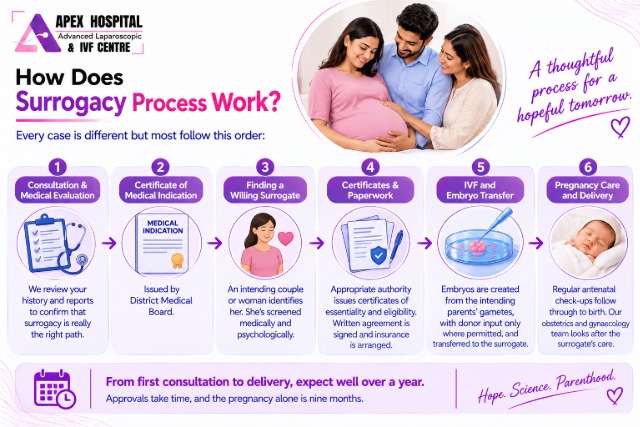
How Does Surrogacy Process Work?
Every case is different but most follow this order:
- Consultation and medical evaluation. We review your history and reports to confirm that surrogacy is really the right path.
- Certificate of medical indication. Issued by District Medical Board.
- Finding a willing surrogate. An intending couple or woman identifies her. She’s screened medically and psychologically.
- Certificates and paperwork. Appropriate authority issues certificates of essentiality and eligibility. Written agreement is signed and insurance is arranged.
- IVF and embryo transfer. Embryos are created from the intending parents’ gametes, with donor input only where permitted, and transferred to the surrogate.
- Pregnancy care and delivery. Regular antenatal check-ups follow through to birth. Our obstetrics and gynaecology team looks after the surrogate’s care.
From first consultation to delivery, expect well over a year. Approvals take time, and the pregnancy alone is nine months.
What to Ask Before You Choose a Clinic
A few questions protect you:
- Is the clinic registered under the Act? Can I see the registration number?
- Who will help with the District Medical Board certificate?
- How is surrogate screened, counselled and insured?
- Who drafts the agreement? And who explains it to everyone involved?
- What’s full cost and what isn’t included? Our IVF cost breakdown for Sirsa shows how to read a package.
Be wary of anyone who promises a guaranteed result, offers to pay a surrogate, or skips the certificates. Those are legal problems, not shortcuts.
Surrogacy at Apex Hospital, Sirsa
Apex Hospital, Sirsa has offered IVF and infertility care for years, and surrogacy is now part of that. The medical side is led by Dr. Manisha Mehta, and you can read more about her work on the doctor profile page. Our team can help you check eligibility, understand the paperwork, and plan each stage. Our gynecologists in Sirsa can also help if you want a medical review first. Give us a call on 96196 42000
Surrogacy in India FAQs
Can we pay a surrogate?
No. Commercial surrogacy is banned. Only her medical expenses and insurance coverage can be paid.
Does a surrogate have to be a relative?
No. 2021 Act allows any willing woman who meets the eligibility criteria.
Can a single woman opt for surrogacy?
Only a widow or divorcee aged 35 to 45 with a medical indication. Single men and unmarried couples aren’t eligible.
Whose child is the baby legally?
The intending parents’. The law treats the baby as their biological child from birth.
Can we choose surrogacy because we’d rather not go through pregnancy?
No. The law requires a medical indication, certified by the District Medical Board.
Surrogacy in India: Where This Leaves You
Surrogacy is never a first step. It’s a medical decision made after other routes have been explored. And law treats it that way. That’s why paperwork matters as much as medicine. If you think you might qualify, whether because of an absent or damaged uterus, repeated failed IVF, or health conditions that make pregnancy unsafe.
We recommend starting with a conversation; not a contract. Bring your reports. Ask for the clinic’s registration number. And take your time. Call Apex Hospital, Sirsa on +91 9619642000. Or book through Online OPD, and get an honest assessment of whether surrogacy is right for you.