
Night after night, up twice. Three times. Then four. You tell yourself it’s just age. Maybe it’s the tea you had at dinner. But the bathroom trips keep stacking up, and daytime doesn’t look much better either.
This is often the first sign of an enlarged prostate, and it’s far more common than most men realise. By age 60, roughly half of all men show some degree of it. By 80, that number climbs past 80%. The good news: enlarged prostate symptoms are manageable and usually not a sign of cancer. The catch is that too many men wait years before mentioning them to a doctor. Today,, Apex Hospital – home to best Urologists in Sirsa, Haryana – will break down what to watch for, why it happens, and when it’s time to act.
What Is an Enlarged Prostate, Exactly?
The medical term is benign prostatic hyperplasia, or BPH. The prostate is a small, walnut-sized gland sitting just below the bladder, wrapped around the urethra, the tube that carries urine out of the body. As men age, this gland keeps growing. It’s not cancer, and it’s not an infection. It’s simply tissue doing what aging tissue does.
The trouble starts because of where the prostate sits. As it enlarges, it squeezes the urethra, and that squeeze is what causes nearly every symptom on this list. The bladder has to work harder to push urine past the narrowed passage, and over time, that extra effort shows up as the warning signs below.
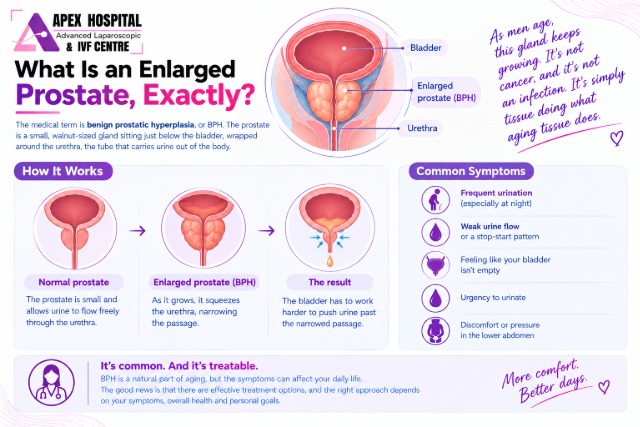
Core Symptoms: What Enlarged Prostate Actually Feels Like
Frequent urination, especially at night
This is usually the symptom that brings men in. Needing to urinate more than twice a night (called nocturia) is one of the clearest early indicators. During the day, it can mean needing a bathroom every hour or two, even when fluid intake hasn’t changed.
Urgency that’s hard to control
A sudden, strong need to urinate that’s difficult to delay. Some men describe it as going from “fine” to “urgent” within seconds, with very little warning in between.
Weak or interrupted urine stream
Instead of a steady flow, the stream starts and stops, or comes out noticeably weaker than it used to. This is the narrowed urethra at work, physically restricting flow.
Difficulty starting urination
Standing at the toilet and waiting, sometimes for a while, before anything happens. Straining to start is common and often gets dismissed as “just how it is now.”
A feeling of incomplete emptying
Walking away from the bathroom still feeling like there’s more to go. This happens because the bladder isn’t fully emptying each time, which can also explain why bathroom trips feel more frequent than they should be.
Dribbling after urination
A small leak or dribble after you’ve finished and moved on. Often mild, but still worth mentioning to a doctor.
Pain or urgency not explained by other symptoms
Less common, but still part of the picture for some men, particularly when inflammation or infection accompanies the enlargement.
Symptoms That Need Same-Day Attention
Most enlarged prostate symptoms build slowly. A few don’t, and those deserve urgent evaluation rather than a wait-and-watch approach:
- Complete inability to urinate. This is a medical emergency known as acute urinary retention.
- Blood in the urine. Even once, even if it clears up on its own.
- Fever with urinary symptoms. This can point to infection involving the prostate or urinary tract.
- Severe pain in the lower abdomen or pelvis alongside urinary symptoms.
None of these should wait for a routine appointment. Call your urologist or go to the hospital directly.
Why This Happens: The Short Version
The prostate grows in response to hormonal changes that occur with aging, largely tied to a hormone called dihydrotestosterone. Researchers don’t fully understand why some men develop significant BPH while others barely notice it, but age is the single biggest risk factor. Family history, obesity, and inactivity also appear to raise the odds.
It’s worth separating this from prostate cancer early on. BPH and prostate cancer can share some symptoms, particularly urinary changes, which is exactly why a proper evaluation matters rather than guessing which one you’re dealing with. Elevated PSA levels can be caused by either condition, and our guide on high PSA levels explains what a raised number actually means and doesn’t mean.

How Doctors Diagnose an Enlarged Prostate
A proper workup usually includes:
- A symptom review, often using a standardised scoring tool to track severity over time
- A digital rectal exam, which lets the doctor physically assess the prostate’s size and texture
- A urine flow test, measuring how quickly and completely the bladder empties
- PSA blood testing, to help rule out other prostate conditions
- Ultrasound, in some cases, to get a clearer picture of prostate size and bladder function
None of these tests are painful or lengthy, and together they give a much clearer answer than symptoms alone.
Treatment Options: From Watchful Waiting to Surgery
Treatment depends entirely on how much the symptoms are affecting daily life.
Mild symptoms often just need monitoring, along with simple changes like cutting back on evening fluids and limiting caffeine or alcohol.
Moderate symptoms usually respond well to medication. Alpha-blockers relax the muscles around the prostate and bladder neck, improving flow fairly quickly. Other medications work more slowly to shrink the gland itself over months.
Severe or persistent symptoms may need a procedural approach. TURP (transurethral resection of the prostate) remains one of the most established options, and our urology in Sirsa department sees it work well for men whose symptoms haven’t responded to medication. For very large prostates, other approaches may apply, and our page on prostate removal surgery walks through the types, costs, and recovery involved.
Left untreated for years, an enlarged prostate can eventually contribute to bladder stones or recurrent infections, which is part of why conditions like cystolitholapaxy surgery sometimes enter the conversation for men who’ve gone a long time without addressing BPH symptoms. If kidney stones are also part of your history, it’s worth knowing how PCNL surgery and URS for kidney fit into urology care more broadly, since the two conditions often get managed by the same team.
Frequently Asked Questions About Enlarged Prostate Symptoms
Is an enlarged prostate the same as prostate cancer?
No. BPH is a non-cancerous enlargement. The two can share symptoms, which is why proper testing matters rather than assuming either one.
At what age should men start watching for these symptoms?
Symptoms can begin as early as the 40s, but they become significantly more common after 50. Regular checkups from your mid-40s onward are a reasonable baseline.
Can lifestyle changes alone manage mild symptoms?
For mild cases, yes. Reducing evening fluids, limiting caffeine and alcohol, and avoiding prolonged bladder-holding can meaningfully help.
Does an enlarged prostate always need surgery?
No. Many men manage symptoms long-term with medication alone. Surgery is usually reserved for moderate-to-severe cases that haven’t responded to other treatment.
Is frequent urination at night always related to the prostate?
Not always, but it’s one of the most common and recognisable signs in men over 50, and worth mentioning to a doctor regardless of the cause.
Where This Leaves You
Enlarged prostate symptoms rarely show up overnight. They build slowly: a few extra bathroom trips, a weaker stream, a little more urgency, until one day it’s hard to remember what normal used to feel like. None of that needs to be quietly tolerated. Frequent urination, a weak stream, incomplete emptying and nighttime trips are all worth a conversation with a urologist, especially once you’re past 50. Catching it early keeps your options wider and your evenings a lot less interrupted.
If these symptoms sound familiar, call Apex Hospital, Sirsa on +91 9619642000, or book directly through Online OPD, and get your prostate checked properly rather than guessing at home.