It starts as a dull ache in the back. Within an hour, it can turn into one of the sharpest pains a person will ever feel. That’s the reality of kidney stone pain symptoms — they escalate fast, and knowing what’s normal to manage at home versus what needs a hospital visit can save you a very rough night.
At Apex Hospital – best urologist hospital in Sirsa, we see patients across the full spectrum: some walk in describing mild discomfort they assumed was a muscle pull, others arrive doubled over, unable to sit still. Here’s how to tell the difference, and when it’s time to stop waiting it out.
What Causes Kidney Stones?
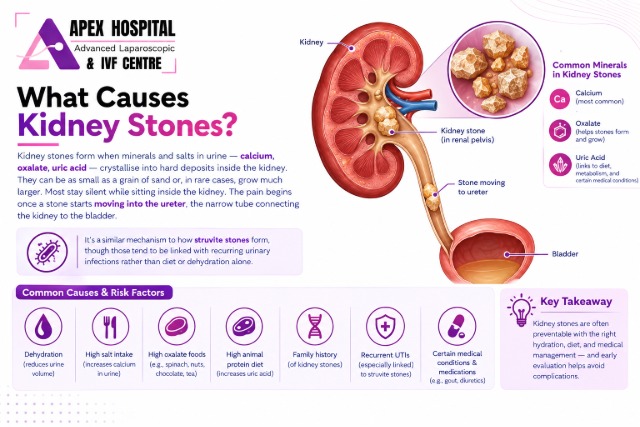
Kidney stones form when minerals and salts in urine — calcium, oxalate, uric acid — crystallise into hard deposits inside the kidney. They can be as small as a grain of sand or, in rare cases, grow much larger. Most stay silent while sitting inside the kidney. The pain begins once a stone starts moving into the ureter, the narrow tube connecting the kidney to the bladder.
It’s a similar mechanism to how struvite stones form, though those tend to be linked with recurring urinary infections rather than diet or dehydration alone.
What Kidney Stone Pain Actually Feels Like
Where It Starts
The classic description is pain in the side or back, just below the ribs. It doesn’t stay put, though — as the stone travels down the ureter, the pain often shifts, moving toward the lower abdomen and groin.
How It Behaves
This is what catches most people off guard. Kidney stone pain typically:
- Comes in waves, intensifying and easing in cycles rather than staying constant
- Fluctuates in location as the stone moves
- Doesn’t get better no matter what position you try
- Can radiate to the groin or inner thigh
- Is often paired with a burning sensation while urinating
Symptoms That Usually Come Along With It
- Blood in the urine (sometimes visible, sometimes only picked up on a test)
- Nausea or vomiting
- A frequent, urgent need to urinate, even when little comes out
- Cloudy or foul-smelling urine
According to Mayo Clinic, pain intensity and location can shift as the stone moves through the urinary tract, which is why it’s often mistaken for other conditions early on. If several of these line up with sudden flank pain, a kidney stone is a strong possibility — and it’s worth getting checked rather than assuming it’s a pulled muscle or general back pain.
When Kidney Stone Pain Becomes a Hospital Visit
Not every stone needs an emergency trip. Many small stones pass on their own with fluids and pain relief. But certain signs mean you shouldn’t wait for a regular appointment:
- Pain so severe you can’t sit still or find any comfortable position
- Fever or chills along with the pain
- Persistent vomiting that won’t let you keep fluids down
- Visible blood in the urine
- Difficulty urinating, or being unable to pass urine at all
- Pain lasting more than a few hours without any relief
Fever combined with flank pain deserves particular attention — it can mean the stone has caused an infection behind a blockage, which needs urgent treatment rather than home management. The same logic applies to any sudden, severe abdominal pain: conditions like appendicitis causes can mimic stone pain early on, which is exactly why a proper evaluation matters instead of guessing which organ is to blame.
Dr. R.K. Mehta recently shared simple, practical ways to lower your risk of kidney stones – from daily water intake to diet habits that actually make a difference.
How Kidney Stones Are Diagnosed
A urologist will usually start with a history of your symptoms and a physical exam, followed by imaging. A CT scan is the most reliable way to locate a stone and check its size, though ultrasound is often used first, especially when repeated imaging needs to be avoided. Urine and blood tests help check for infection and identify what the stone is made of, which matters for preventing future ones. Cleveland Clinic notes that stone size and location largely determine whether a stone needs active treatment or can be left to pass on its own.
Treatment Options: From Watching and Waiting to Surgery
Small stones — generally under 5mm — often pass on their own with plenty of water and pain relief. Your doctor may also prescribe medication that relaxes the ureter to help the stone move along more easily.
Larger stones, or ones causing a blockage, infection, or pain that won’t resolve, usually need active treatment. At Apex Hospital, our urology team offers:
- PCNL (Percutaneous Nephrolithotomy): Used for larger stones, where a small tract is created to remove the stone directly from the kidney
- URS (Ureteroscopy): A scope is passed through the urinary tract to break up and remove the stone, with no external incision
Both are minimally invasive procedures, and most patients recover quickly compared to older open-surgery techniques. If you’ve read our piece on recovery after laparoscopic gallbladder surgery, the underlying philosophy is the same here — smaller access points mean less pain, less downtime, and a faster return to normal life.
Preventing the Next Stone
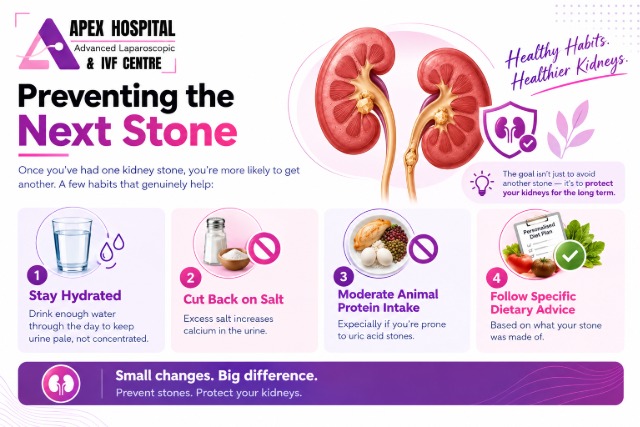
Once you’ve had one kidney stone, you’re more likely to get another. A few habits that genuinely help:
- Drinking enough water through the day to keep urine pale, not concentrated
- Cutting back on excess salt, which increases calcium in the urine
- Moderating animal protein intake if you’re prone to uric acid stones
- Following any specific dietary advice based on what your stone was made of
Frequently Asked Questions
How long does kidney stone pain usually last?
An individual wave of pain can last minutes to hours, and the overall episode may continue for a few days until the stone passes or is treated.
Can kidney stone pain come and go?
Yes — this is actually typical. Pain often comes in cycles as the stone moves and the ureter spasms around it.
Is kidney stone pain worse than labour pain?
Many patients describe it as one of the most intense pains they’ve experienced, and it’s often compared to labour pain in intensity, though this varies from person to person.
Do all kidney stones need surgery?
No. Many small stones pass on their own with hydration and pain management. Surgery is reserved for larger stones, blockages, infections, or stones that won’t pass.
Can kidney stones cause permanent kidney damage if left untreated?
Yes, in some cases. A stone that blocks urine flow for a prolonged period can lead to kidney damage or infection, which is why persistent symptoms shouldn’t be ignored.
Don’t Try to Wait Out Severe Pain
Mild kidney stone discomfort can often be managed at home with fluids and medication. But sudden, severe, or worsening pain — especially with fever or vomiting — needs prompt evaluation, not a wait-and-see approach.
The urology team at Apex Hospital, Sirsa, led by Dr. R.K. Mehta, has extensive experience managing kidney stones of every size, from simple monitoring to advanced PCNL and URS procedures. Reach out to us if your symptoms match what’s described here.