Repeated IVF Failure Treatment
- Home
- Repeated IVF Failure Treatment
Repeated IVF Failure Treatment in Sirsa, Haryana
Repeated IVF failure is generally defined as not achieving pregnancy after two or more well-performed IVF cycles. In Haryana, many couples seek advanced fertility evaluation after unsuccessful IVF attempts to understand the underlying cause and improve outcomes in the next cycle.
At Apex Hospital, Sirsa, repeated IVF failure is approached with detailed evaluation rather than repeating the same protocol. Every case is assessed based on embryo quality, uterine health, hormonal balance, and individual medical history before planning the next step.
“Repeated IVF failure is not just about trying again; it is about understanding why it didn’t work earlier and correcting that,” explains Dr. Manisha Mehta at Apex Hospital.

If you’ve had unsuccessful IVF cycles, consult our fertility expert to understand what can be done differently.
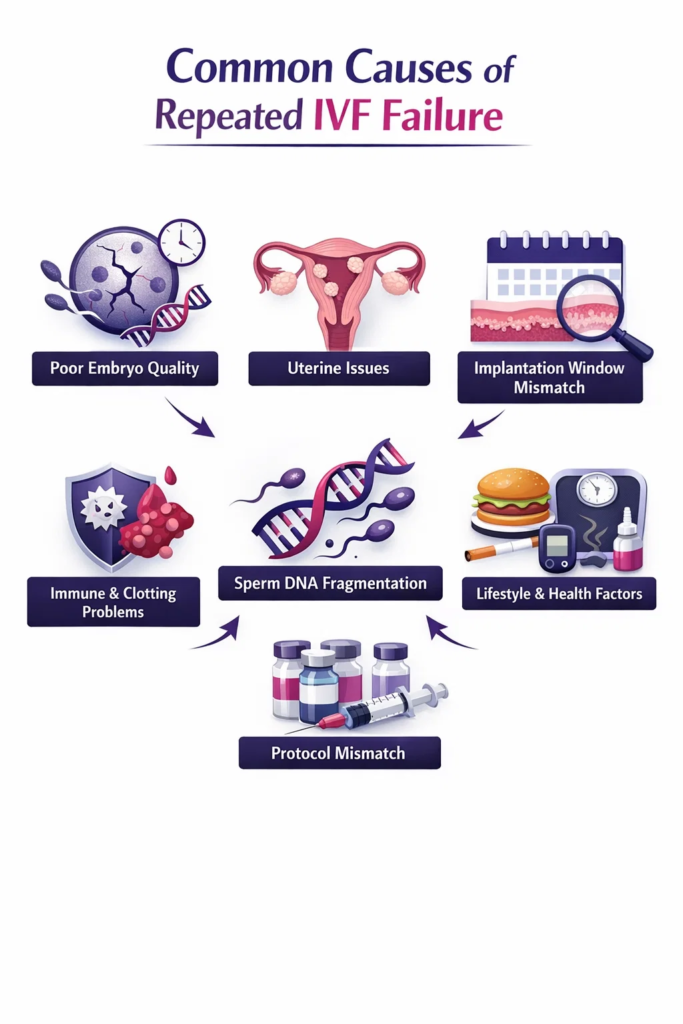
Common Causes of Repeated IVF Failure
Most failed cycles come down to one or more of the following reasons. Identifying the actual cause is the first step in any repeat IVF plan at Apex Hospital:
- Poor embryo quality — this can result from declining egg quality (age, low AMH), poor sperm quality, or lab conditions during culture. Chromosomally abnormal embryos often fail to implant.
- Uterine factors — thin endometrium, fibroids, polyps, intrauterine adhesions, septate uterus, or untreated endometriosis can all interfere with implantation even when the embryo is healthy.
- Implantation window mismatch — in some women, the endometrium is receptive on a different day than the standard transfer day. Tests like ERA (Endometrial Receptivity Assay) identify this.
- Immunological and clotting issues — conditions such as antiphospholipid syndrome, elevated NK cells, or untreated thyroid imbalance can prevent implantation or cause early loss.
- Sperm DNA fragmentation — even a normal semen report can hide high DNA damage, which lowers fertilisation quality and embryo potential.
- Lifestyle and underlying health — untreated diabetes, thyroid disorders, obesity, smoking, and stress are often overlooked contributors.
- Protocol mismatch — the same stimulation protocol does not suit every ovary. Women with PCOS, low AMH, or poor response need individualised protocols, not standard templates.
Unsure which of these may apply to your case? A detailed review of your previous IVF reports will give you clarity.
Evaluation after IVF failure
Before planning another cycle, a detailed review is essential. This may include:
- Hormonal testing and ovarian reserve assessment
- Uterine evaluation (ultrasound, hysteroscopy if needed)
- Embryo quality review from previous cycles
- Genetic screening in selected cases
- Sperm DNA fragmentation testing
At Apex Hospital, this evaluation helps avoid repeating the same cycle blindly and instead focuses on targeted correction.
Treatment options after repeated IVF failure
The treatment approach depends on what is found during evaluation. Common strategies include:
- Changing stimulation protocol to improve egg quality
- Using advanced embryo selection techniques
- Endometrial preparation for better implantation
- Treating uterine abnormalities before next cycle
- Using ICSI or advanced fertilisation techniques if required
In some cases, minor adjustments can significantly improve the chances of success.
Why choose Apex Hospital for repeated IVF failure treatment in Sirsa?
Repeated IVF failure requires a more detailed and thoughtful approach, not just another attempt. At Apex Hospital, Sirsa, the focus is on understanding the complete picture before planning the next cycle.
- Detailed review of previous IVF cycles
Every past cycle is analysed, including stimulation response, egg quality, fertilisation rate, and embryo development, to identify possible gaps. - Root cause identification, not repetition
Instead of repeating the same protocol, the treatment plan is modified based on what may have affected implantation or embryo quality earlier. - Comprehensive fertility evaluation
Hormonal testing, uterine assessment, and sperm quality analysis are done again if required to rule out missed factors. - Advanced fertility techniques available
Options like ICSI, improved embryo selection, and better lab protocols are used when indicated to improve outcomes. - Personalised cycle planning
The next IVF cycle is planned carefully with changes in medication, timing, and embryo transfer strategy based on individual response. - Doctor-led decision making
Each step, from stimulation protocol to embryo transfer, is guided by clinical judgement rather than a fixed template.
FAQs
Repeated IVF failure usually means not achieving pregnancy after 2–3 IVF cycles with good quality embryos.
Yes, many couples conceive after identifying and correcting the cause behind previous failures.
Yes, egg quality declines with age, which directly affects IVF success.
Not always. What matters is whether your case is being evaluated and treated differently.
Yes, uterine and hormonal factors can often be corrected with proper treatment.