TESA PESA Treatment in Sirsa, Haryana: A Complete Guide to Male Infertility Treatment
When a couple finds out that conceiving naturally may not be possible, it turns their world upside down. And when the reason points to the male partner .. specifically, no sperm in the semen, the silence in that moment can feel very heavy. But here is what we want you to know before anything else: this is not the end of your parenthood journey. It is simply a different path. TESA and PESA are two proven, safe sperm retrieval procedures that make it possible for men with zero sperm count to father their own biological child. At Apex Hospital, Sirsa, we have walked this path with many couples, and we can walk it with you too.
Book a Free Consultation Today
What Is TESA PESA?
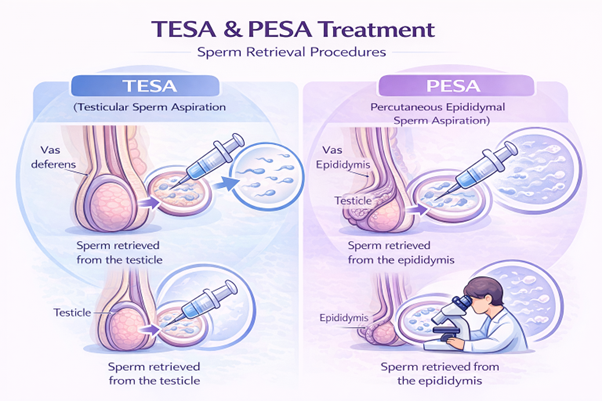
Let us start simply. TESA and PESA are minimally invasive procedures used to retrieve sperm directly from the male reproductive system, bypassing the natural ejaculation process entirely.
- TESA Full Form: Testicular Sperm Aspiration, a fine needle collects sperm from inside the testicular tissue itself.
- PESA Full Form: Percutaneous Epididymal Sperm Aspiration, sperm is gently drawn from the epididymis, the coiled tube sitting just behind the testicle, through the skin with no surgical cut.
Both procedures are short. Both are outpatient. You come in, the procedure is done under local anesthesia, and you go home the same day. That is it.
Who Needs TESA PESA Treatment?
Once couples understand what TESA and PESA mean, the next natural question is , does this apply to us? To answer that, we first need to understand why some men have no sperm in their semen.
Understanding Azoospermia
The medical term is azoospermia, the complete absence of sperm in the ejaculate. It affects nearly 1% of all men and accounts for 10–15% of male infertility cases across India. There are two types, and the difference matters when choosing between TESA and PESA.
Obstructive Azoospermia means sperm is being produced, but a blockage somewhere along the reproductive tract prevents it from reaching the semen. This could be due to a vasectomy, absent vas deferens, scarring from a past infection, or previous surgery.
Non-Obstructive Azoospermia means the testes themselves are producing very little or no sperm, often linked to hormonal imbalances, genetic conditions, or testicular dysfunction.
Ideal Candidates for TESA PESA
You may be a candidate for TESA or PESA if you have:
• Zero sperm count confirmed on semen analysis (azoospermia)
• Had a vasectomy in the past and wish to have a child now
• Congenital bilateral absence of the vas deferens (CBAVD)
• Undergone a vasectomy reversal that did not succeed
• Retrograde ejaculation , where sperm enters the bladder instead of being released
• Blockages caused by past infections or injury
If any of these sound familiar, please do not wait. An early evaluation makes a real difference.
TESA PESA Procedure: Step-by-Step
Knowing exactly what happens during the procedure often reduces fear. So let us walk you through it — simply and honestly.
PESA Procedure (Percutaneous Epididymal Sperm Aspiration)
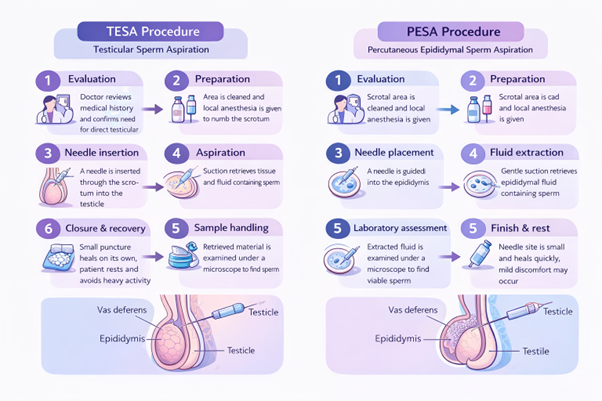
● Local anesthesia is given to numb the area completely A fine needle is gently inserted through the scrotal skin into the epididymis
● Fluid is carefully aspirated using a syringe
● The sample is checked immediately under a microscope for viable sperm
● Retrieved sperm is prepared for ICSI
TESA Procedure (Testicular Sperm Aspiration)
● Local anesthesia or light sedation is administered
● A thin needle passes through the scrotal skin directly into the testicle
● Testicular fluid and a small tissue sample are gently aspirated
● Our embryology team processes the sample to identify and isolate healthy sperm
● Viable sperm is used fresh for ICSI or frozen for a future cycle There is no large incision. No stitches. No hospital admission. Most men are surprised by how straightforward the experience actually is.
Difference Between TESA and PESA
Now that you understand both procedures, here is a clear side-by-side comparison to help you see how they differ and why your doctor’s recommendation will always be based on your specific diagnosis.
Feature | TESA | PESA |
Full Form | Testicular Sperm Aspiration | Percutaneous Epididymal Sperm Aspiration |
Sperm Source | Testicles | Epididymis |
Invasiveness | Slightly more | Less |
Best For | Non-obstructive azoospermia | Obstructive azoospermia |
Anesthesia | Local / Light sedation | Local anesthesia |
Duration | 15–30 mins | 10–15 mins |
Sperm Maturity | Immature sperm | More mature sperm |
The right choice between TESA and PESA is never a guess. It is based on your semen analysis, hormone levels, and clinical history. Our specialists in Sirsa will assess everything before recommending a path forward.
MESA, TESA, and PESA: What Is MESA?
In some complex cases, neither PESA nor TESA retrieves enough sperm. That is when MESA (Micro-epididymal Sperm Aspiration) becomes an option.
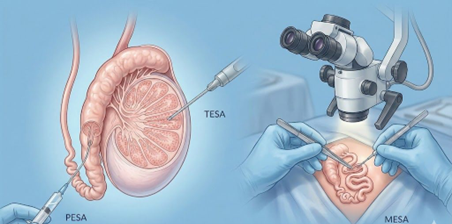
MESA is performed under general anesthesia using a high-powered surgical microscope. It allows the surgeon to directly visualise the epididymis, retrieve a larger volume of sperm, and ensure higher quality. It is recommended only for specific obstructive cases where other methods fall short.
Think of it as a natural progression: PESA → TESA → MESA, from the least to the most involved. Your doctor will always start with the most suitable, least complex option for your condition.
TESA PESA and ICSI: The Complete Fertility Pathway
Retrieving sperm is only one part of the picture. The sperm collected through TESA or PESA cannot fertilise an egg on their own; they need ICSI, where a single healthy sperm is injected directly into a mature egg with extraordinary precision.
Here is how the complete journey unfolds at Apex Hospital, Sirsa:
Any extra sperm retrieved can be cryopreserved; frozen safely for future IVF cycles. One procedure. Multiple opportunities.
Book a Free Consultation Today
TESA PESA Side Effects and Risks
It is completely natural to wonder what to expect after the procedure. The reassuring truth is that side effects are minimal and temporary.
You may experience mild soreness or swelling at the needle site for a day or two. Some men notice minor bruising around the area; this settles on its own. Infection is extremely rare when the procedure is performed with sterile technique in a proper medical setting. Mild anesthesia-related sensations resolve quickly. There is no scarring since no incision is made, and no long-term side effects have been reported with either procedure.
At Apex Hospital, Sirsa, every procedure follows strict sterile protocols under experienced hands, so your comfort and safety are never compromised.
Recovery After TESA PESA Treatment
Recovery is genuinely easy. Here is what the first few days look like:
- You go home the same day , no admission needed
- Rest for the remainder of the day of the procedure
- Mild pain relief medication is prescribed if needed for 1–2 days
- Wearing supportive underwear keeps discomfort minimal
- Avoid heavy lifting or strenuous physical activity for about one week
- Most men return comfortably to their normal routine within 2–3 days
Success Rates of TESA and PESA
For men with obstructive azoospermia, PESA carries a very high sperm retrieval success rate, because sperm production itself is normal, just blocked. For non-obstructive azoospermia, TESA achieves successful sperm retrieval in 30–50% of cases, depending on the underlying cause.
When retrieved sperm is combined with ICSI, fertilisation rates improve meaningfully. And because retrieved sperm can be frozen, you may not need to repeat the procedure if multiple IVF cycles become necessary, making the process both practical and cost-conscious for families in Sirsa and across Haryana.
Every case is different. Your success rate depends on your individual diagnosis, your partner’s egg quality, and all of which we assess thoroughly before your treatment begins.
Says Dr R.K.Mehta. We are promised to provide consistent and high-quality care to patients.
Why Choose Apex Hospital, Sirsa for TESA PESA?
Families from Sirsa, Hisar, Fatehabad, Dabwali, and surrounding areas choose Apex Hospital for a reason that goes beyond equipment and expertise; they feel genuinely cared for here.
What you can expect with us:
- Experienced fertility specialists and andrologists who have handled complex male infertility cases with proven outcomes
- Advanced IVF and embryology lab with modern sperm retrieval and IC Technology
- Same-day coordination of TESA/PESA with egg retrieval — no extra visits, no Delays
- Personalised treatment plans — because no two patients are the same
- Transparent, affordable pricing with no hidden charges
- Compassionate support through every stage — from your first consultation to embryo transfer
Your dream of holding your own child is worth pursuing. We are here to make that pursuit as smooth, informed, and hopeful as possible.
Frequently Asked Questions (FAQ)
TESA stands for Testicular Sperm Aspiration, and PESA stands for Percutaneous Epididymal Sperm Aspiration. Both are minimally invasive procedures used to retrieve sperm in men with azoospermia for use in IVF/ICSI treatment.
PESA collects sperm from the epididymis and works best for obstructive azoospermia. TESA retrieves sperm from testicular tissue and is used for non-obstructive azoospermia or when PESA does not yield sufficient sperm.
No. Both are performed under local anesthesia. You may feel mild soreness for a day or two afterwards, which is easily managed with basic pain relief medication.
Side effects are minimal, mild bruising, swelling, or discomfort lasting one to two days. Infection is very rare. No long-term side effects have been reported with either procedure.
PESA has a high retrieval success rate for obstructive cases. TESA has a 30–50% retrieval rate for non-obstructive azoospermia. When combined with ICSI, pregnancy success rates improve significantly based on individual factors.